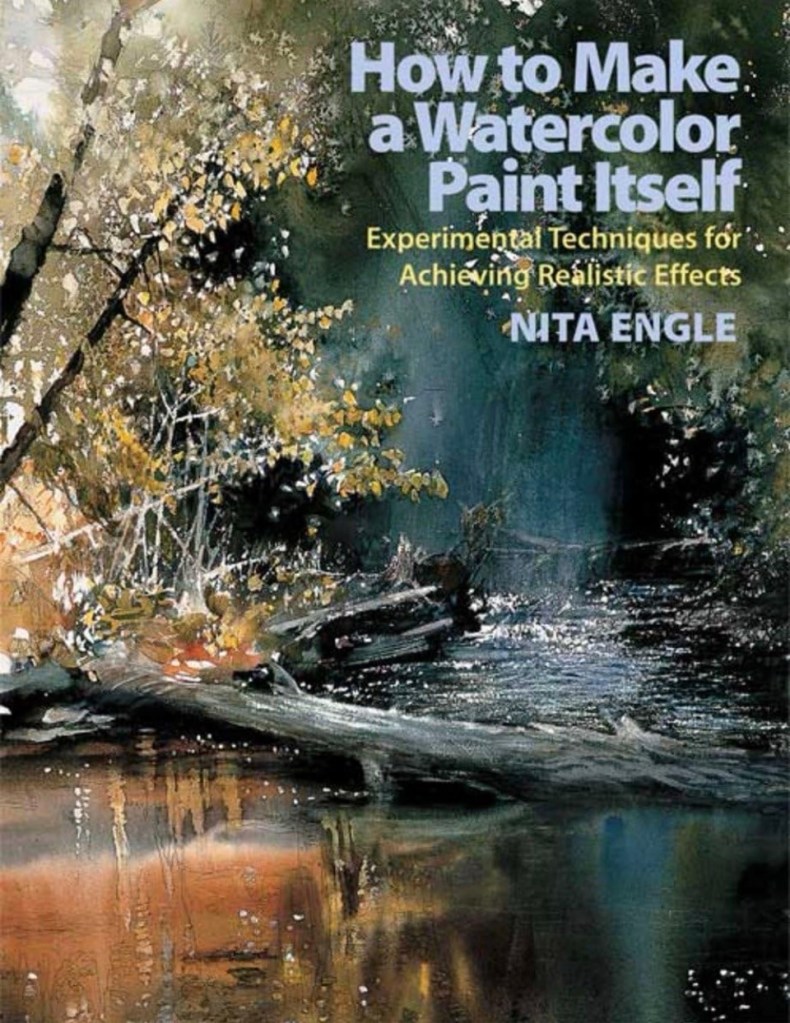
There are watercolor books that teach technique, and then there are watercolor books that quietly change the way you see paint itself. How to Make a Watercolor Paint Itself by Nita Engle belongs in that second category.
What struck me most while reading this book was how deeply observant Nita was of the natural world. She understood that watercolor is not supposed to be forced into submission. She let water move, separate, bloom, stain, and granulate in ways that feel alive on the paper. Instead of fighting the medium, she built entire landscapes around what watercolor naturally wants to do.
Her landscape work is especially impressive because of her command of values. Even in passages filled with texture and loose atmospheric effects, the paintings never lose their structure. Darks are placed with intention. Soft passages still have form. There is a confidence to the way she balances light against shadow that gives her work an emotional weight without becoming overworked.
One of the most interesting parts of the book is seeing the variety of tools and materials she experimented with to create texture. She did not limit herself to brushes alone. Spattering, scraping, lifting, masking, stamping, and unconventional texturing tools all became part of her language as a painter. The effects never feel gimmicky or decorative for the sake of decoration. They serve the landscape. Rocks feel weathered. Trees feel rough and organic. Mist feels suspended in air. You can tell she was constantly exploring what watercolor could become.
I also appreciated that the book does not talk down to the reader. There is generosity in the way she explains process. She shares techniques openly, but the real lesson underneath all of it is observation, patience, and trust in the medium.
Knowing that Nita Engle has passed away adds another layer to reading this book now. It feels less like a standard instruction manual and more like sitting beside an artist who spent decades learning how water, pigment, texture, and light interact with one another. Her voice and artistic philosophy remain very present in these pages.
For watercolorists who love landscapes, texture, atmosphere, and expressive paint handling, this book is worth spending time with slowly. Not just for the techniques themselves, but for the way it encourages you to loosen your grip a little and allow watercolor to do some of the work alongside you.


 Artful things
Colorful comments appreciated